MCP-EP
Simultaneous Multi-Contact Localization and Force Identification
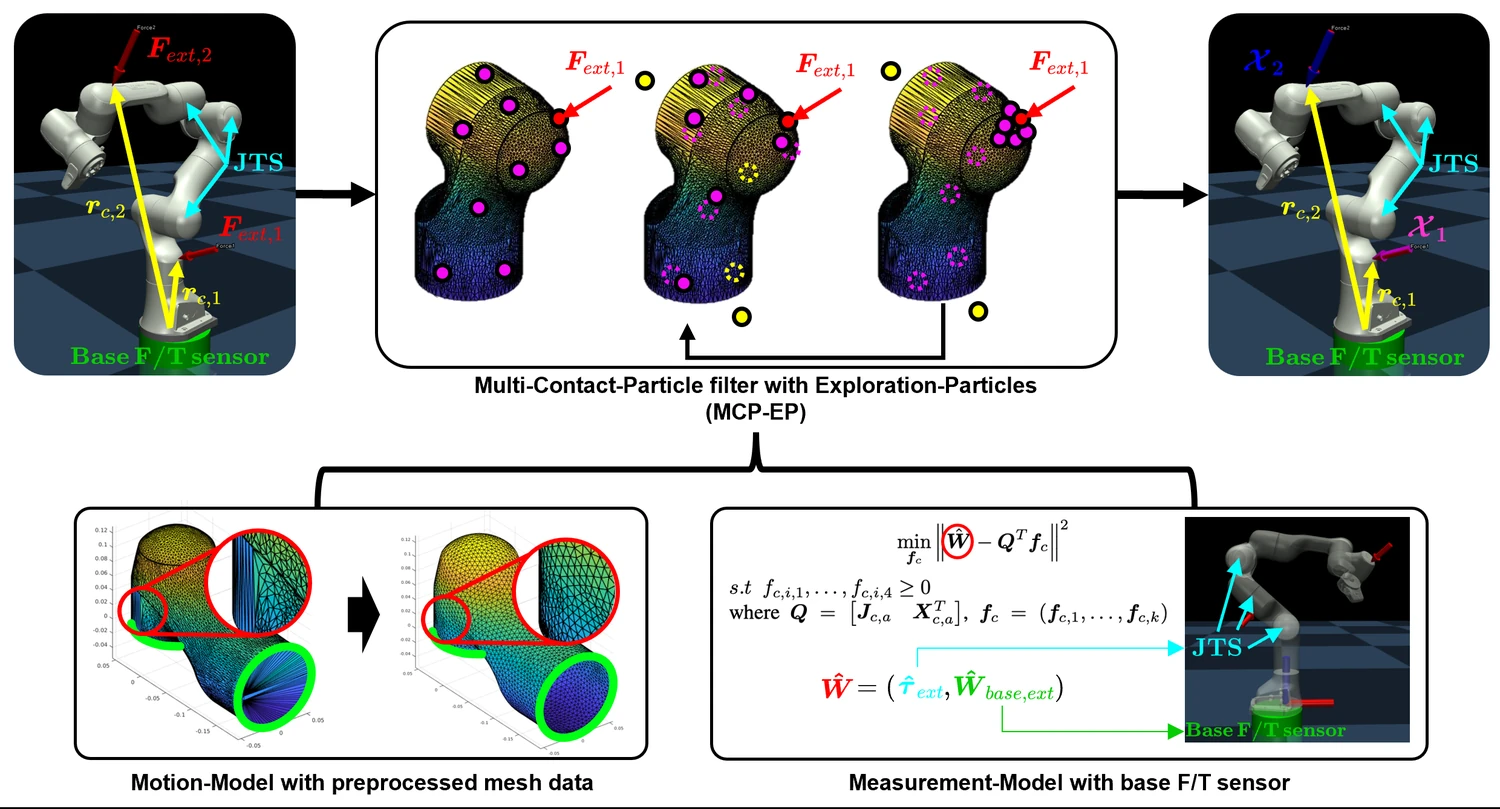
A multi-contact particle filter combines preprocessed robot meshes, exploration particles, and a base force/torque sensor to estimate contact locations and forces without tactile skin.
IEEE ICRA · 2023
Locating Contacts and Identifying Forces
MCP-EP estimates contact positions and forces from joint torque sensors and a force/torque sensor at the robot base. The base measurement adds six sensing degrees of freedom, helping distinguish contacts that joint torque measurements alone cannot identify, particularly on links near the base. The method supports several simultaneous contacts without a tactile skin.
Fast Particle Updates on Robot Meshes
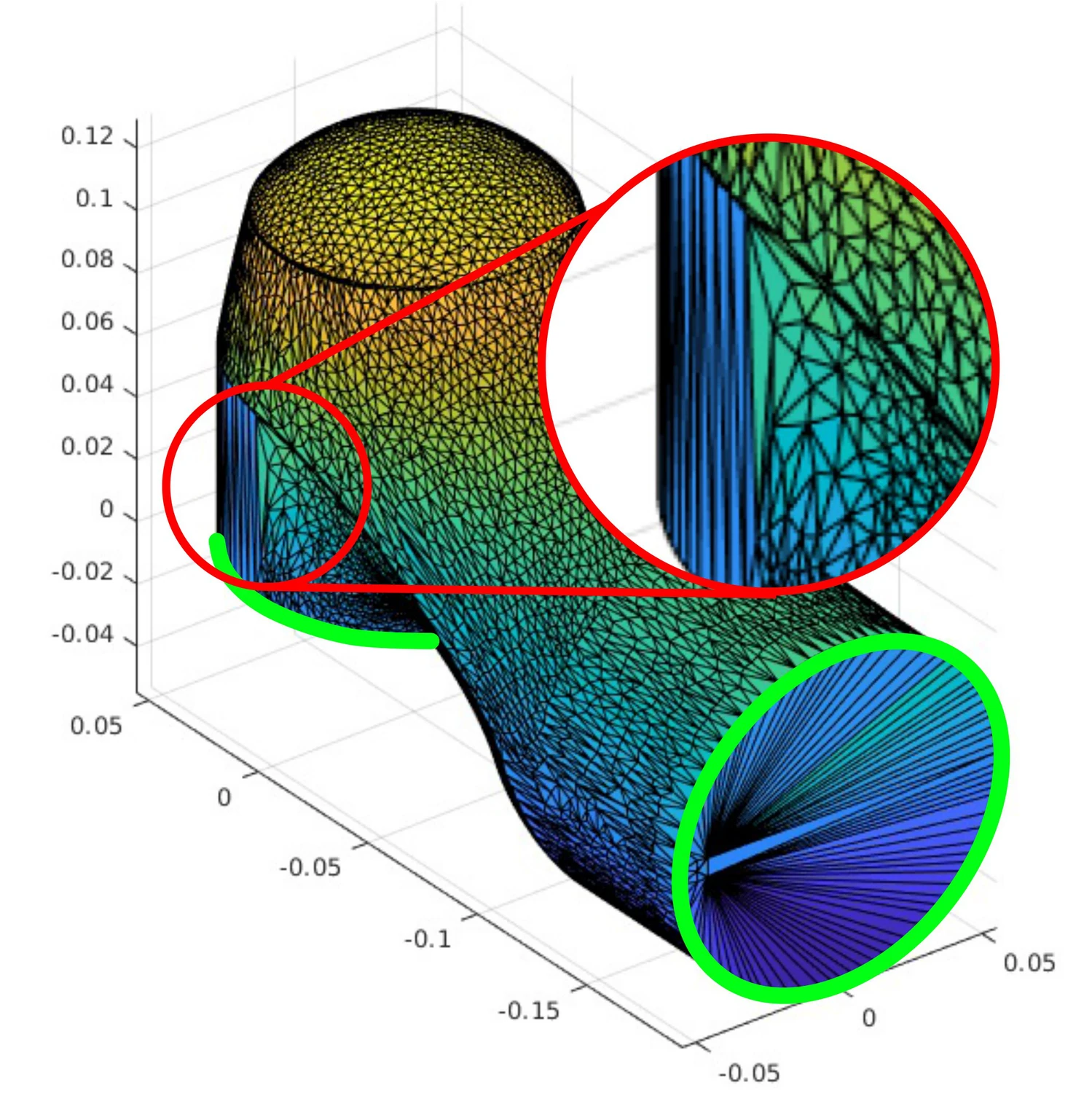
The robot mesh is preprocessed into nearly uniform faces, and geodesic distances between faces on each link are computed offline. A particle can then move over the surface through a lookup and face-index update. For a proposed contact location, a convex quadratic program finds forces consistent with the sensor measurements and a polyhedral friction cone. Its residual determines the particle weight.
Exploration Across Links
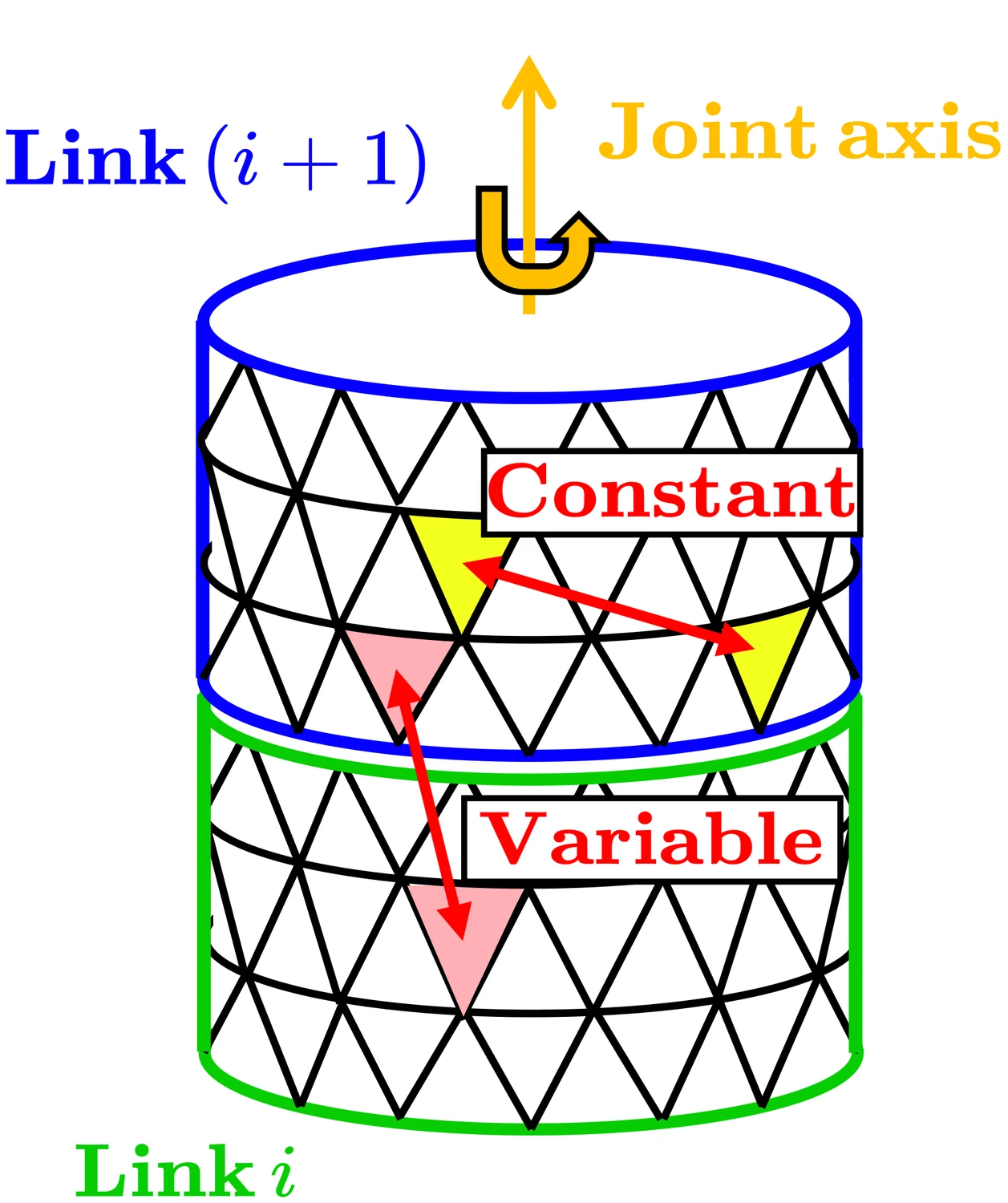
Distances between different links change as the robot moves and cannot use the same fixed lookup. Exploration particles search adjacent links, allowing the estimate to move away from an incorrect link. Particle sets are added or removed when the current contact hypotheses no longer explain the sensor measurements, or when a set becomes unnecessary.
Simulation Validation
Each contact condition was evaluated in 10,000 randomized trials using a seven-degree-of-freedom Franka Emika Panda in MuJoCo. A 20 N force was applied at each sampled contact, with at most one contact per link. Success means localization error no greater than 2.25 cm. The reported RMSE values include failed trials.
| Contacts | Success | Position RMSE | Force RMSE | Runtime |
|---|---|---|---|---|
| 1 | 99.96% | 0.16 cm | 0.01 N | 0.45 ms |
| 2 | 96.70% | 1.08 cm | 2.00 N | 1.66 ms |
| 3 | 81.63% | 3.50 cm | 4.63 N | 4.50 ms |
Supplementary Real-World Demonstrations
The videos show contact estimation on a Kinova Gen3. These demonstrations are separate from the simulation statistics reported above.
MCP-EP supplies the contact estimator in Multi-Contact Feedback MPC and serves as a comparison method for ContactFlowFilter.
Representative Publications
Proprioceptive Sensor-Based Simultaneous Multi-Contact Point Localization and Force Identification for Robotic Arms
Seo Wook Han and Min Jun Kim
IEEE International Conference on Robotics and Automation (ICRA), 2023
Bib
@inproceedings{han2023proprioceptive,
  title={Proprioceptive Sensor-Based Simultaneous Multi-Contact Point Localization and Force Identification for Robotic Arms},
  author={Han, Seo Wook and Kim, Min Jun},
  booktitle={IEEE International Conference on Robotics and Automation (ICRA)},
  pages={12099--12105},
  year={2023}
}Figures, demonstrations, and research details: author's project page.
Explore more in Physical AI