Multi-Contact Feedback MPC
Safe Predictive Control under Unexpected Contacts
Real-time model predictive control uses multi-contact feedback to regulate contact forces during interactive tasks, including unexpected pushes and unknown loads.
IEEE ICRA · 2024
Interactive Tasks with Unexpected Contacts
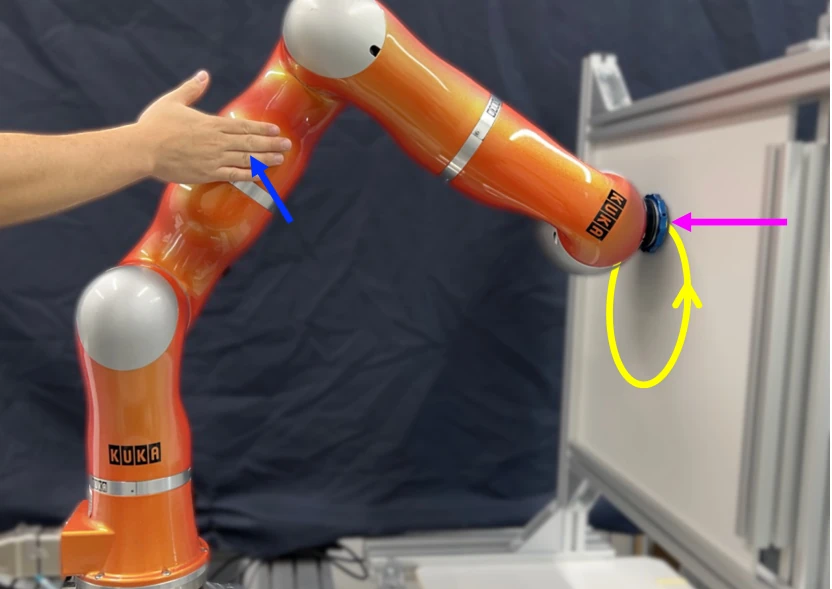
A robot performing a contact task may also be pushed by a person or encounter an obstacle elsewhere on its arm. Multi-Contact Feedback MPC accounts for these contacts explicitly, rather than assuming that interaction occurs only at a known end-effector location. It combines motion and force objectives with limits on unwanted contact forces.
An Explicit Contact Feedback Loop
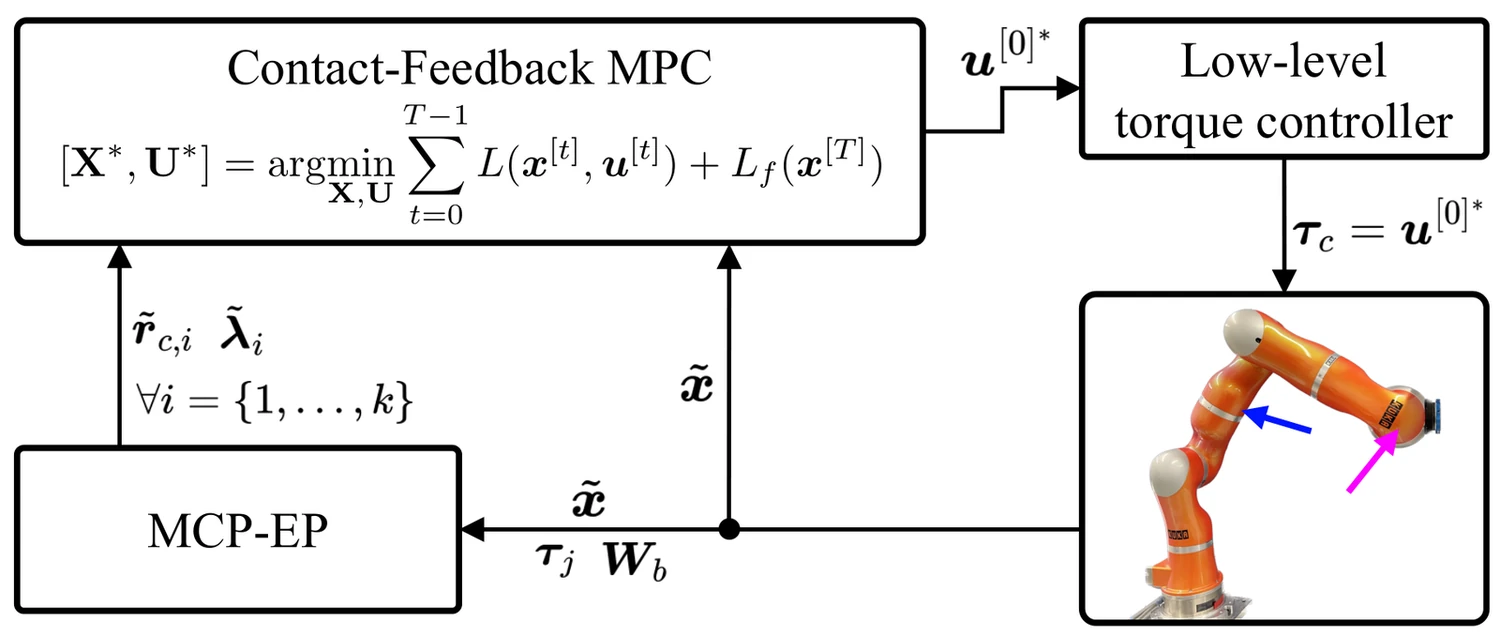
MCP-EP estimates contact locations and forces from joint torque and base force/torque measurements. The controller incorporates this information into a spring contact model and predicts its effect on the full seven-degree-of-freedom robot dynamics. Other estimators can also supply the feedback if they provide multi-contact information in real time.
Contact Modeling and Optimization
The spring model predicts force along the estimated contact direction while leaving tangential motion unconstrained. The optimization combines end-effector pose tracking, contact-force regulation, and a force barrier that penalizes approaching or exceeding the permitted force.
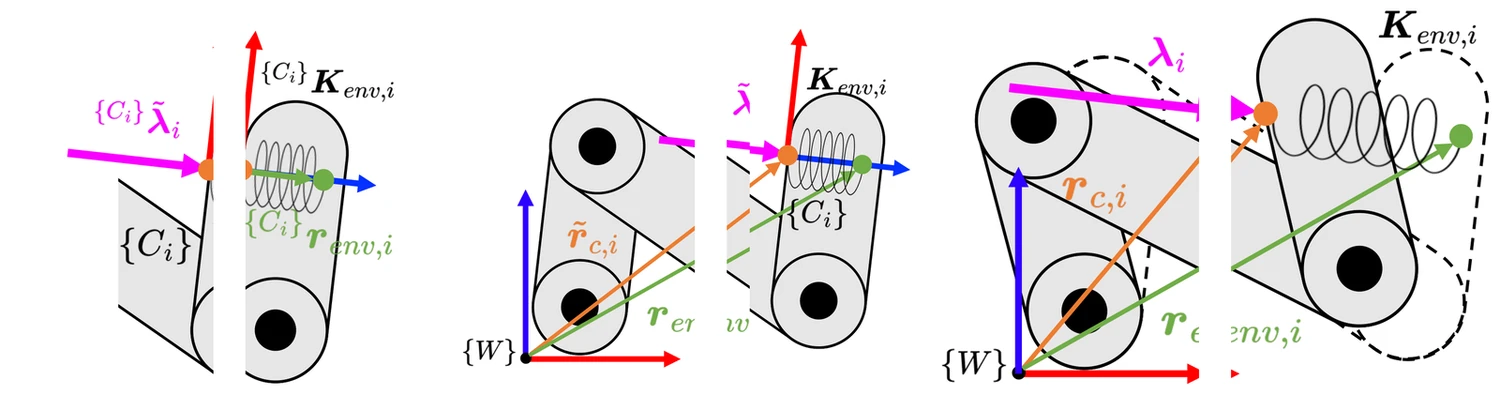
Box-FDDP solves the optimal control problem with analytic derivatives and a 125 ms prediction horizon. Reported update rates are 6.8 kHz without contact, 1.9 kHz with one contact, and 1.8 kHz with two contacts. The implementation retains the full robot dynamics without the simplifying assumptions discussed in the source paper.
Experiments on the DLR-KUKA LWR IV+
Limiting an Unexpected Contact
When an unknown obstacle prevents the arm from reaching its target, MPC without contact feedback produces a peak force of 65.87 N. With contact feedback and a 15 N force limit, the peak is 14.74 N.
Hybrid Motion–Force Control
The robot tracks a circular end-effector trajectory while regulating contact force to 20 N. An additional human contact on the third link is limited to 15 N. The table reports tracking performance during the three phases of this experiment.
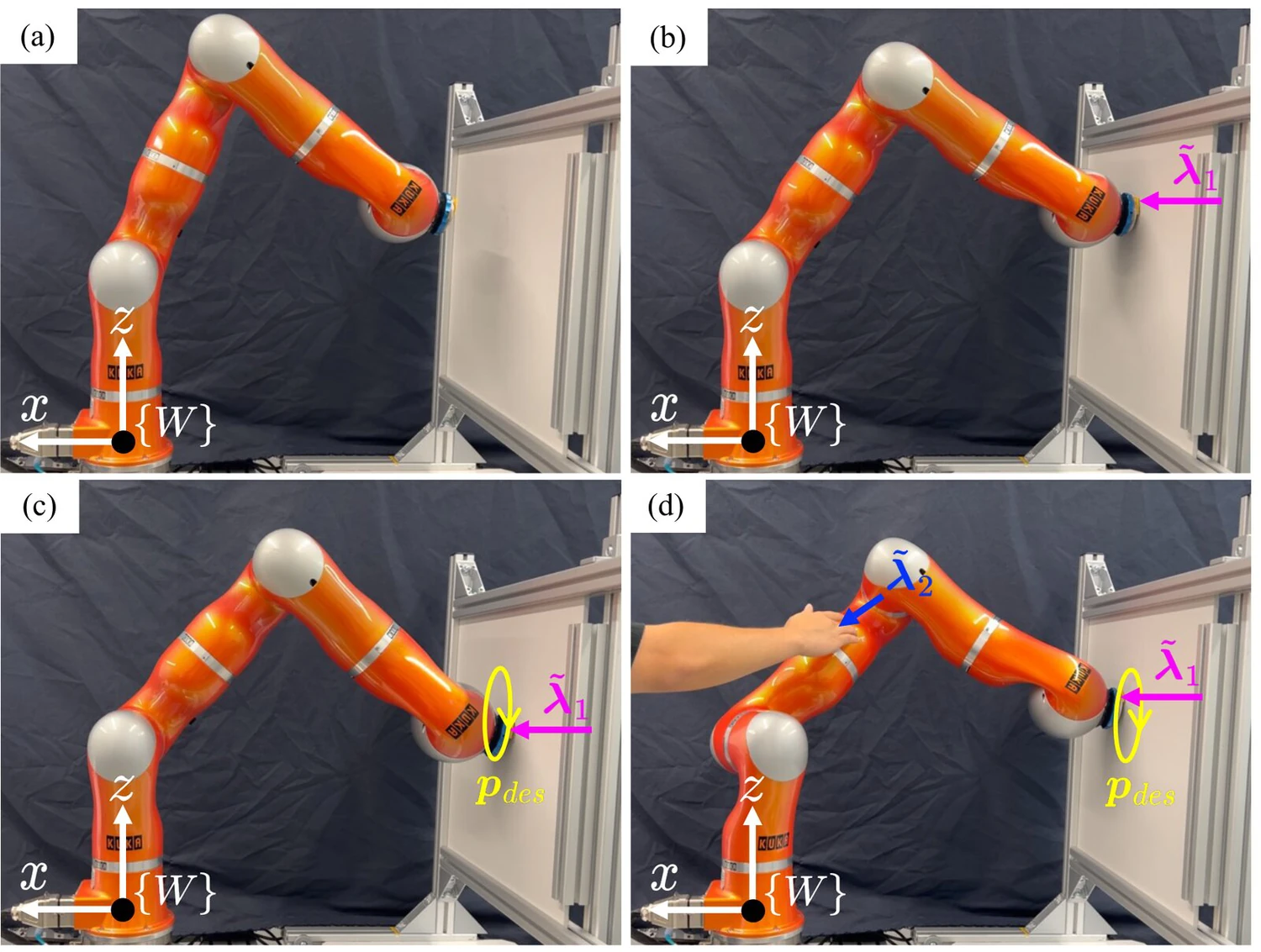
| Phase | Position | Force |
|---|---|---|
| Hybrid motion–force control | 0.86 cm | 0.58 N |
| Additional human contact | 1.14 cm | 0.89 N |
| Constant desired pose | 0.20 cm | 0.10 N |
Representative Publications
Online Multi-Contact Feedback Model Predictive Control for Interactive Robotic Tasks
Seo Wook Han, Maged Iskandar, Jinoh Lee, and Min Jun Kim
IEEE International Conference on Robotics and Automation (ICRA), 2024
Bib
@inproceedings{han2024online,
  title={Online Multi-Contact Feedback Model Predictive Control for Interactive Robotic Tasks},
  author={Han, Seo Wook and Iskandar, Maged and Lee, Jinoh and Kim, Min Jun},
  booktitle={IEEE International Conference on Robotics and Automation (ICRA)},
  pages={11556--11562},
  year={2024}
}Figures, demonstrations, and research details: author's project page.
Explore more in Robot Control & Safety