ContactFlowFilter
Whole-Body Multi-Contact Sensing without Tactile Skin
Proprioception-based contact estimation that senses where a human touches the robot, tracks simultaneous contacts, and works while the arm is moving.
IEEE T-RO · 2026
Contact Estimation as a Distribution
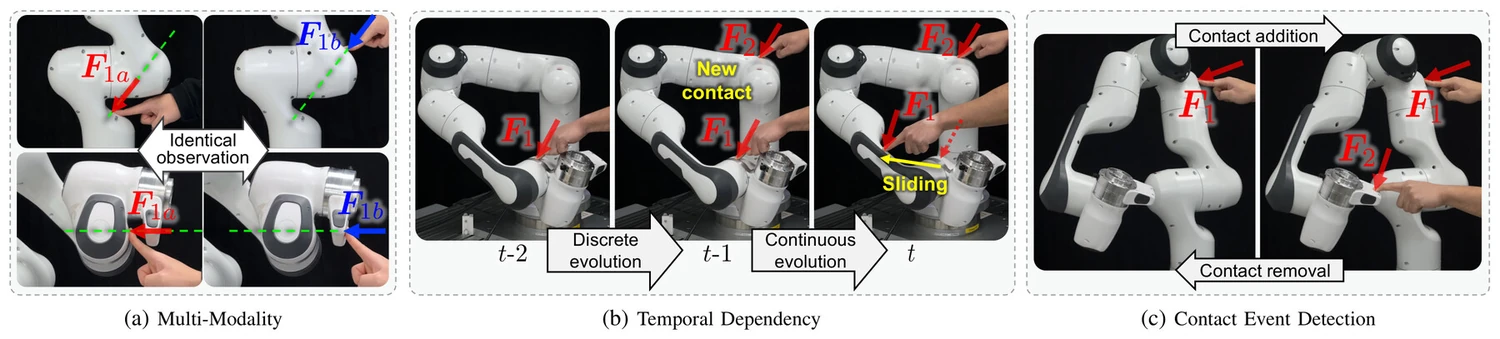
ContactFlowFilter estimates how many contacts are active, where they occur, and the forces they exert using joint torque sensors and a force/torque sensor at the robot base. These measurements do not always identify a unique contact configuration. A useful estimator must retain multiple plausible explanations while following sliding contacts and detecting when contacts appear or disappear.
Combining Flow Matching and Particle Filtering
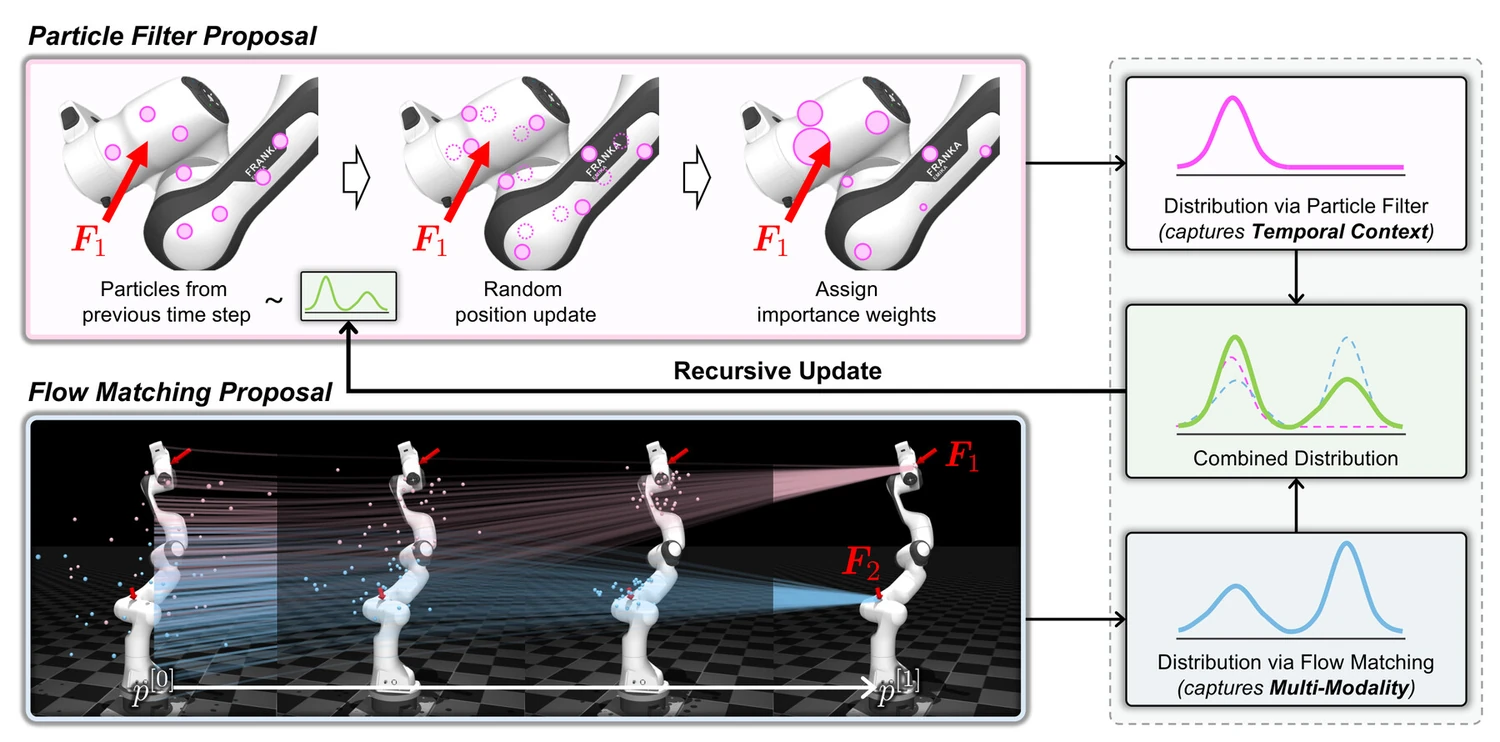
The estimator combines the temporal prediction of a particle filter with samples generated by a flow matching model. The learned proposal can place particles in plausible regions that ordinary resampling has missed. The particle filter then weighs those proposals against the previous estimate, retaining a recursive representation of the contact state.
What Makes the Estimator Work
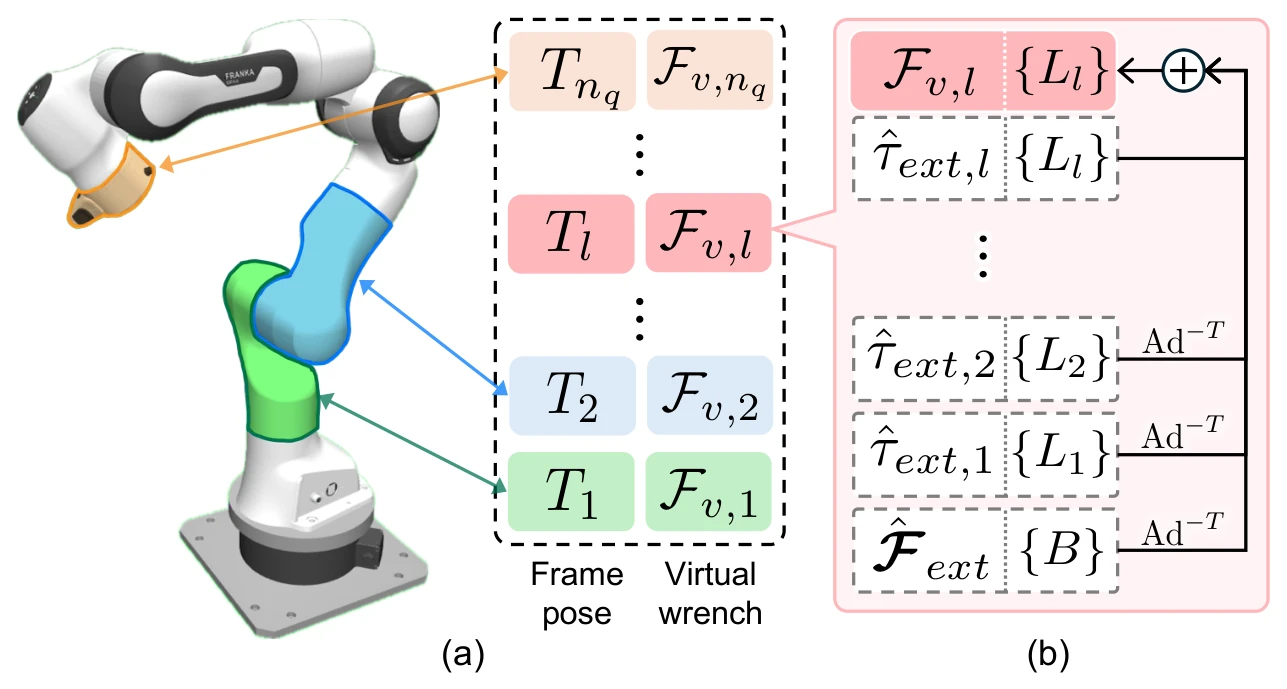
- Sensor representation. A transformer processes link poses and virtual wrenches. Paired contact-point samples encode both single- and dual-contact states.
- Few-step generation. Flow matching produces useful proposals with two integration steps and runs asynchronously from the main estimator.
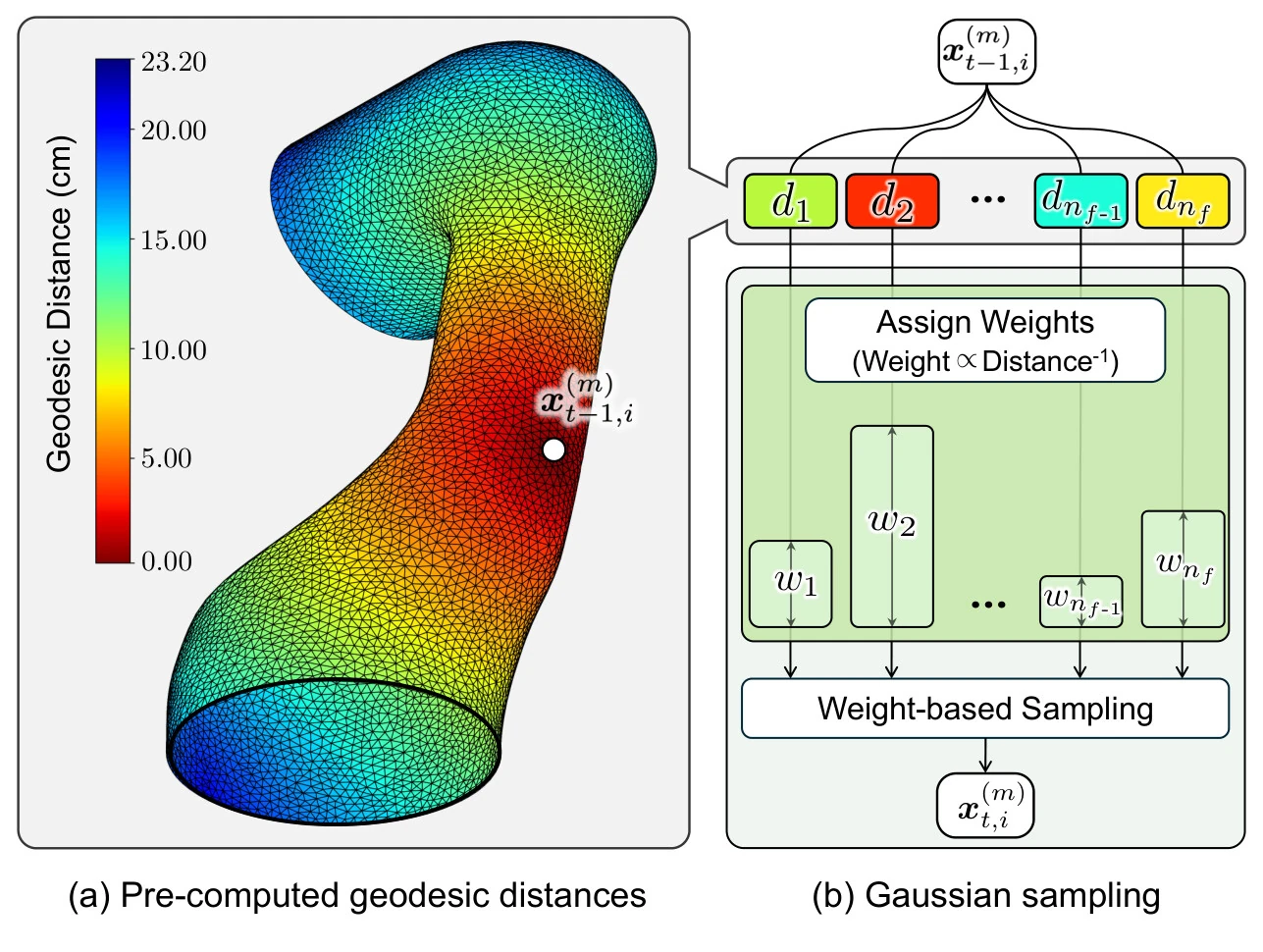
- Surface-aware prediction. Precomputed geodesic distances support particle motion along the robot surface.
- Contact-event detection. Generative proposals and quadratic-program residuals jointly decide when to add or remove a particle set.
Real-World Evaluation
A model trained in simulation was transferred directly to a Franka Emika Panda. The evaluation covered 200 trials across 20 robot configurations, with a force/torque sensor and OptiTrack markers providing ground truth. The table reports mean localization M-RMSE from Experiment D; smaller values are better.
| Method | Single contact | Dual contact |
|---|---|---|
| ContactFlowFilter | 0.36 | 0.88 |
| CPF | 1.36 | 5.49 |
| MCP-EP | 0.77 | 2.44 |
| Dual-particle proposal only | 0.51 | 1.04 |
In a separate 2,000-trial simulation study of contact addition and removal, the particle-set management fault rate was 0.75%, compared with 16.50% for the baseline at matched execution time. These event-detection results are separate from the real-world localization errors above.
Related projects: Contact Diffusion Model and MCP-EP.
Representative Publications
Mixture of Flow Matching and Particle Filter for Proprioception-Based Online Contact Estimation
Seo Wook Han and Min Jun Kim
IEEE Transactions on Robotics, 2026
Figures, demonstrations, and research details: author's project page.
Explore more in Physical AI