Contact Diffusion Model (CDM)
Generative Multi-Contact Point Localization
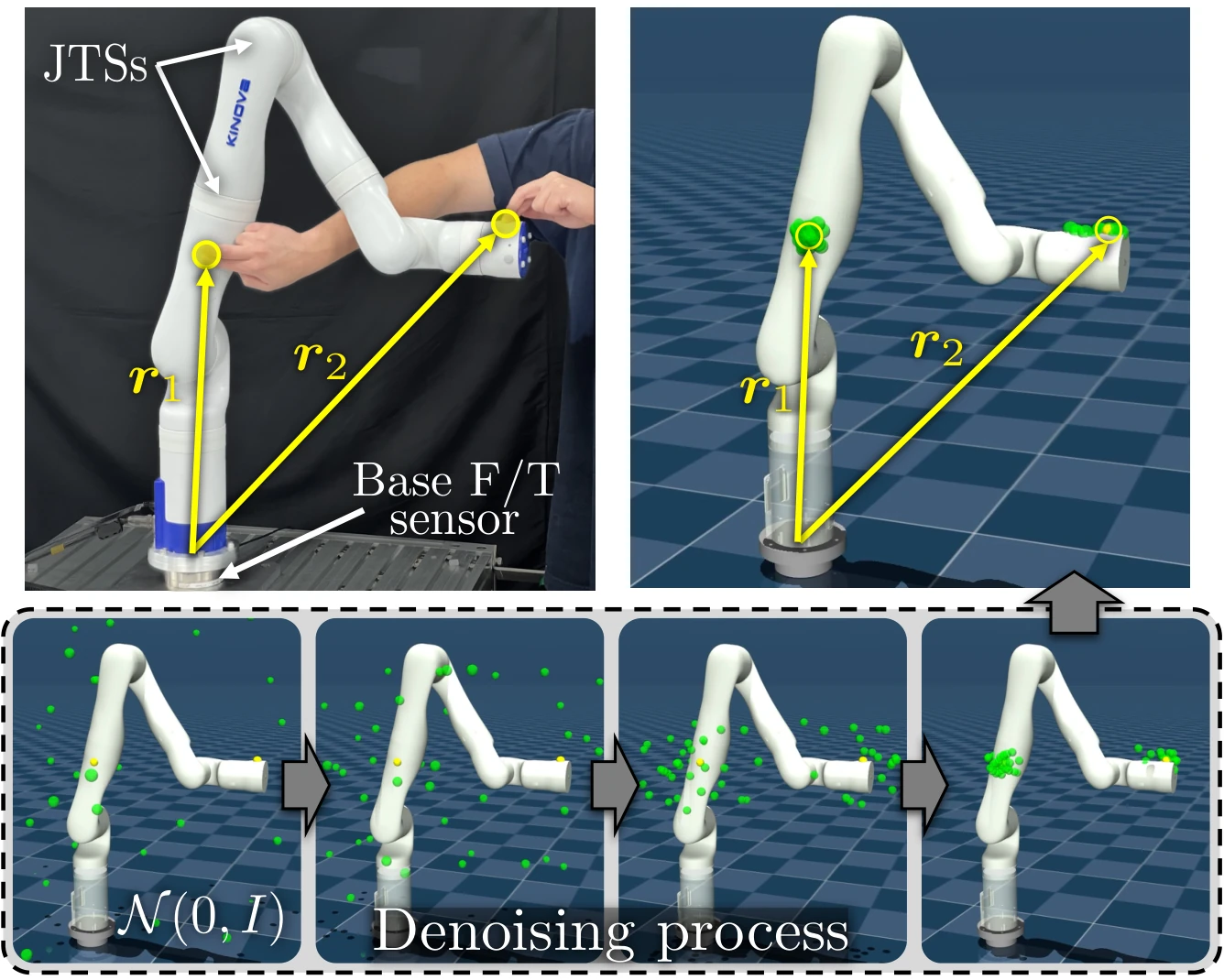
A diffusion model represents multiple contact locations consistent with proprioceptive measurements, using historical estimates and robot-surface geometry to localize single and dual contacts.
IEEE ICRA · 2025
A Generative Model of Contact Locations
Different contact locations and forces can produce the same joint torque and base force/torque measurements. CDM models this ambiguity as a distribution instead of selecting a single explanation. Its diffusion model generates contact-point samples conditioned on proprioceptive measurements, previous estimates, and the geometry of the robot surface.
Temporal Context and Surface Geometry
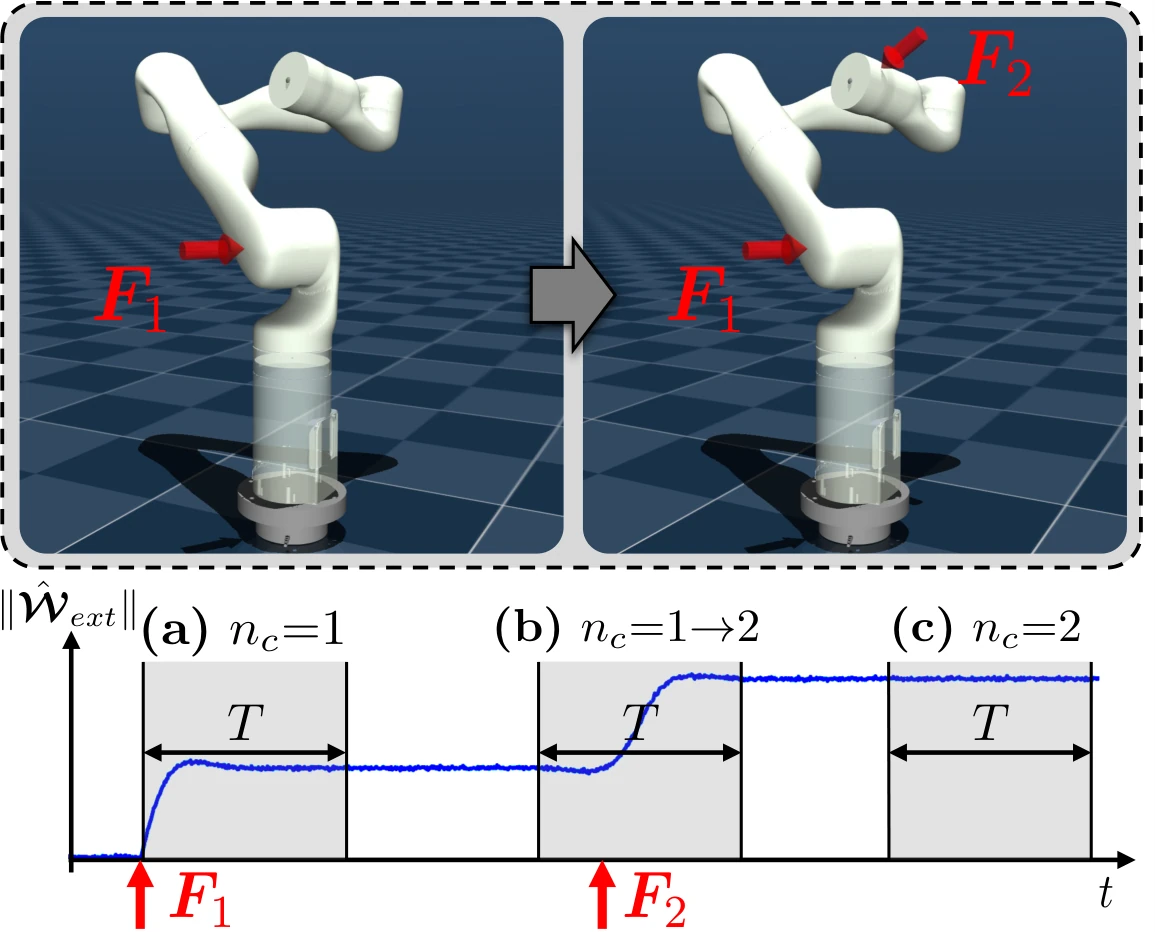
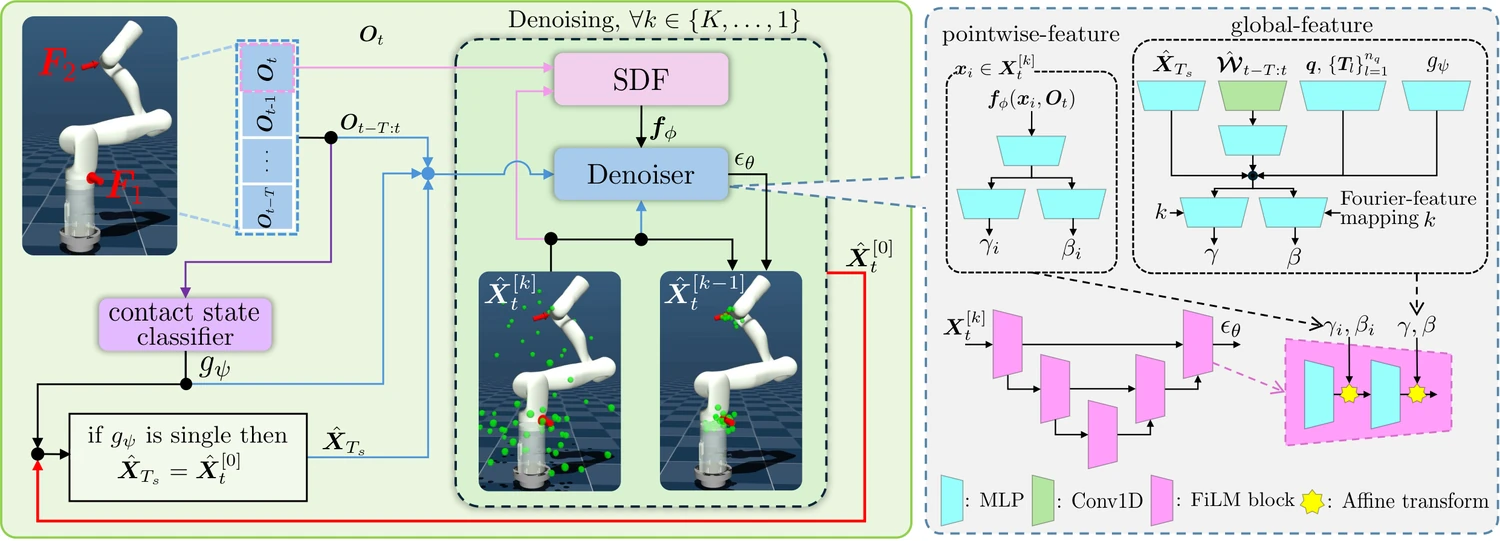
A short observation window can lose information about an earlier contact once a second contact occurs. CDM conditions on an earlier single-contact estimate to retain this context. A contact-state classifier controls when that historical estimate is updated, and the model can also run without a historical estimate.
Signed distance fields describe the robot's link surfaces and guide generated points toward physically meaningful locations. The denoising network uses these surface features alongside sensor measurements and historical diffusion outputs. Each sample uses 64 points to represent the contact distribution.
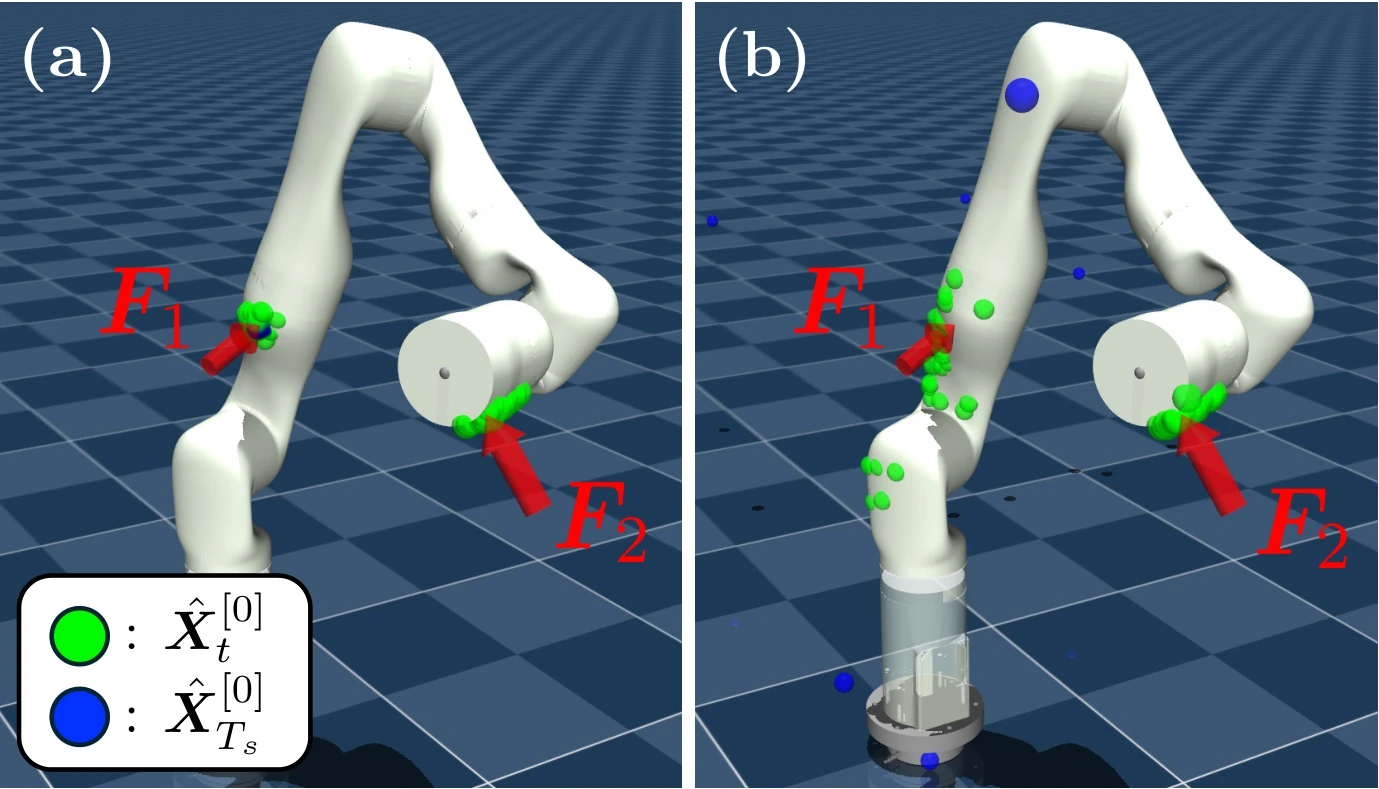
Direct Transfer to a Real Robot
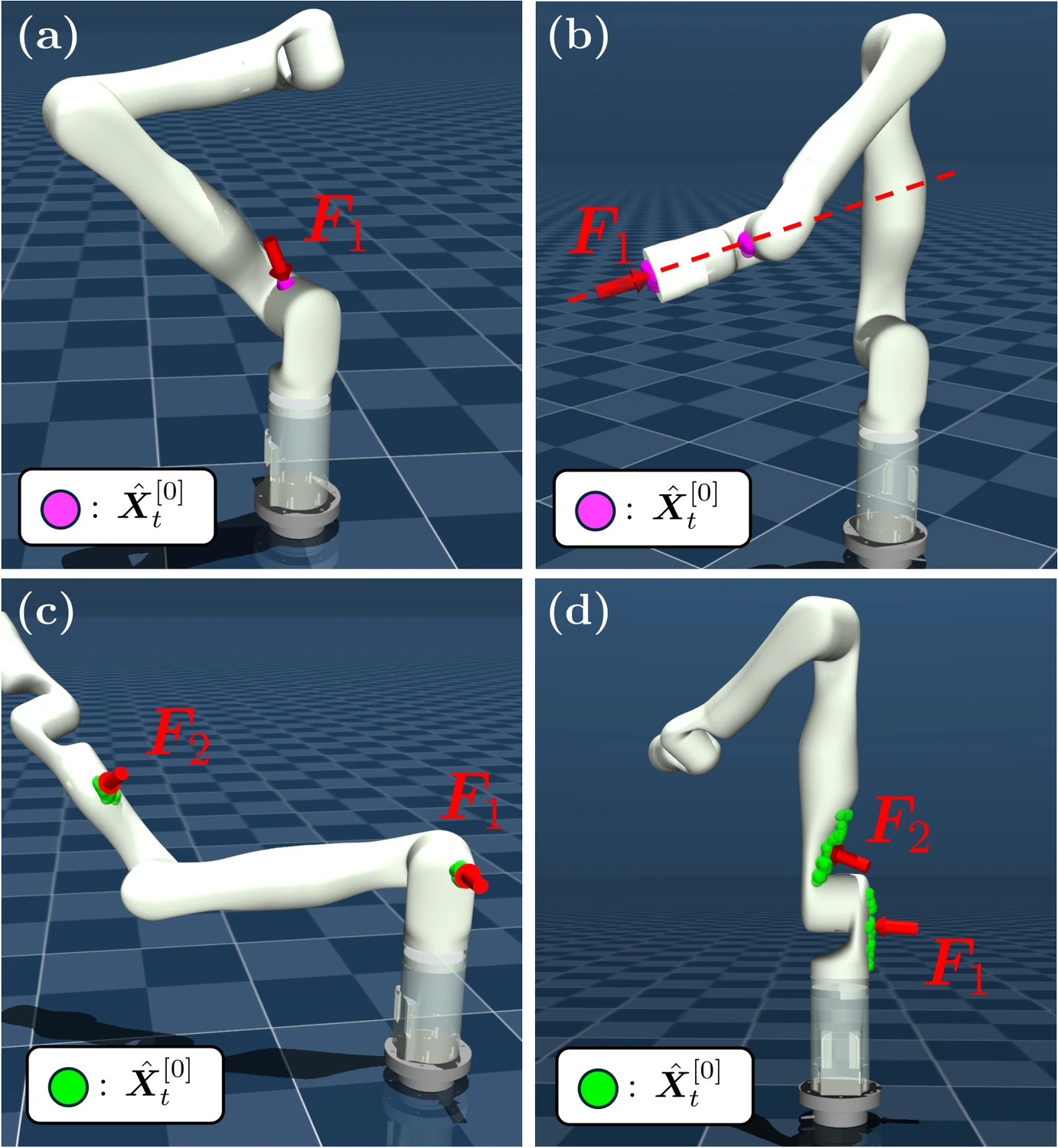
Training data was collected in MuJoCo with noisy joint torque and base force/torque measurements. The model was then evaluated on a Kinova Gen3 with an ATI Mini85 base sensor. Each contact condition was tested 100 times, changing the robot configuration every 20 trials.
| Contact state | Trials | M-RMSE | C-RMSE-1 | C-RMSE-2 |
|---|---|---|---|---|
| Single | 100 | 0.44 | 0.68 | — |
| Dual | 100 | 1.24 | 2.61 | 2.85 |
In simulation ablations, historical conditioning reduces M-RMSE from 1.33 cm to 0.62 cm. Surface conditioning reduces the average distance from generated points to the robot surface from 0.89 cm to 0.29 cm. These measure different effects and are separate from the real-world localization results above.
The follow-up project, ContactFlowFilter, combines a generative proposal with particle filtering to estimate forces and reason recursively about changing contacts.
Representative Publications
CDM: Contact Diffusion Model for Multi-Contact Point Localization
Seo Wook Han and Min Jun Kim
IEEE International Conference on Robotics and Automation (ICRA), 2025
Figures, demonstrations, and research details: author's project page.
Explore more in Physical AI