Whole-Arm Physical Intelligence
Enabling robots to sense, understand, and use contact across their entire arms.
Giving robots whole-arm physical intelligence: we develop robots that can sense, understand, and use contact across their entire arms.
Humans often use the shoulder, elbow, forearm, and hand together when interacting with the environment. Contact across the arm helps us guide motion, distribute force, and adapt when the surroundings are uncertain. Most robot manipulation, however, still focuses primarily on positioning and controlling the end-effector.
This end-effector-centered view leaves much of the robot arm underused. Contacts along the arm are often treated simply as collisions, even though they can provide useful information about the environment and support more coordinated ways of performing a task. Enabling robots to recognize and make use of these interactions requires perception and action to be considered together.
Our research explores how a robot can instead use its whole arm as an interface for both sensing and action. This goal brings together two closely related directions: Whole-Arm Sensing and Whole-Arm Manipulation.
Whole-Arm Sensing

Whole-Arm Sensing enables a robot to perceive where and how physical interaction occurs across its arm. By extending contact awareness beyond the gripper, the robot can better understand its physical relationship with the surrounding environment.
Rather than treating the arm only as a mechanism for positioning the hand, this direction considers every link as a potential point of interaction. Such awareness becomes especially important when a robot works close to objects, people, or confined spaces, where contact may occur at several parts of the arm and change throughout a task. The aim is to give the robot enough information to recognize these interactions and respond appropriately.
Whole-Arm Manipulation
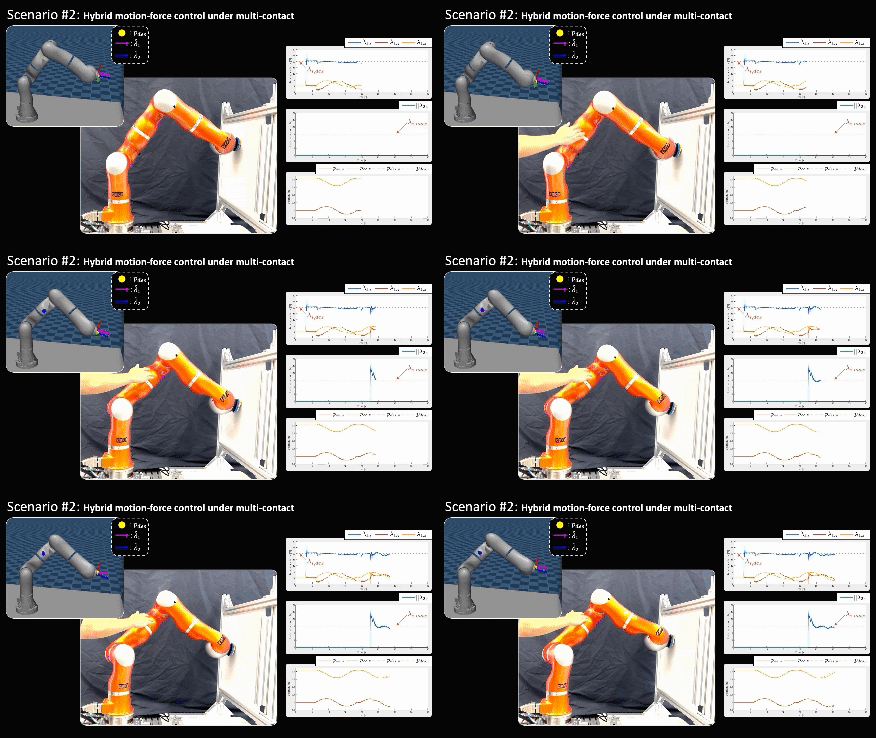
Whole-Arm Manipulation studies how robots can learn to coordinate motion and contact across the entire arm. Through whole-arm teleoperation and learning, our research aims to capture how humans use posture and physical interaction to perform tasks, and to transfer these behaviors into adaptable robot policies.
Human manipulation involves more than following a hand trajectory. We continually adjust the configuration of the arm, decide how to engage with the environment, and redistribute motion and force as a task develops. Whole-arm teleoperation provides a natural way to demonstrate these coordinated behaviors, while learning allows robots to turn the demonstrations into strategies that can adapt to new interactions and task conditions.
The two directions address complementary parts of the same problem. Sensing makes physical interaction across the arm observable, while manipulation studies how that interaction can guide learned behavior. Viewed together, they allow a robot to understand how its body is engaged with the environment and determine how to use that interaction as part of a task. This integrated perspective forms the basis of whole-arm physical intelligence.
Representative Publications
Whole-Arm Sensing
-
Mixture of Flow Matching and Particle Filter for Proprioception-Based Online Contact Estimation
Seo Wook Han, Min Jun Kim
IEEE Transactions on Robotics (T-RO), 2026 -
CDM: Contact Diffusion Model for Multi-Contact Point Localization
Seo Wook Han, Min Jun Kim
IEEE International Conference on Robotics and Automation (ICRA), 2025 -
Proprioceptive Sensor-Based Simultaneous Multi-Contact Point Localization and Force Identification for Robotic Arms
Seo Wook Han, Min Jun Kim
IEEE International Conference on Robotics and Automation (ICRA), 2023
Whole-Arm Manipulation
- Online Multi-Contact Feedback Model Predictive Control for Interactive Robotic Tasks
Seo Wook Han, Maged Iskandar, Jinoh Lee, Min Jun Kim
IEEE International Conference on Robotics and Automation (ICRA), 2024